
When I was a child, there was a period of time, after my parents divorced that we moved in with my Grandparents. A tiny-two-bedroom house, my dad, 2 grandparents, and 8 kids. And somehow, the house was always spotless. As a child, I thought my grandmother must’ve been Superwoman. I still believe that now. But the longer I’ve been a mother, and the more kids we’ve added to the mix, the more I’ve come to realize that the reason everything stayed sane in that tiny little house was because my grandmother relied heavily on systems. Nothing was “Pinterest-worthy” (except maybe the meals), but everything was clean. Everything functioned seamlessly. And I realize now that we often trade function for expectations.
The hard truth is this: you can design a home that looks like the cover of a magazine and it will NEVER look that way without you spending all day cleaning it, simply to take a picture, post it online, and then have the house absolutely destroyed again in a few short minutes. Or, you can go against the trends a little, maybe sacrifice a bit of “what’s expected” and set up a house that works for you in your current season.

If you had walked into my house five years ago, you would have found a beautiful, “correct” formal dining room that we used exactly twice a year. You also would have found me in the kitchen, tripping over a mountain of plastic blocks while my children clung to my legs. I had a “playroom” back then—it was tucked away in a spare bedroom—but it was a ghost town.
I was living my motherhood by default, following a floor plan designed for a lifestyle I didn’t have. Today, I live by design. I killed the dining room, brought the toys to the hearth, and I’ve never looked back.
The Geography of the Hearth
The biggest mistake we make in home design is assuming children want “their own space.” Children don’t want a “kid cave” in the basement; they want to be where mommy is. In human geography, we call this the Hearth—the center of the home’s warmth and activity.

For the modern homemaker, the hearth is the kitchen and laundry zone.
- The Proximity Rule: A child’s independent play is fueled by the “hum” of their mother’s work. When they can hear the dishes clinking or see you moving, they feel connected enough; able to bring you their favorite monster truck and show you how the wheel spins. But they also feel secure enough to toddle back the play area that is steps away and dive deeper into their imagination.
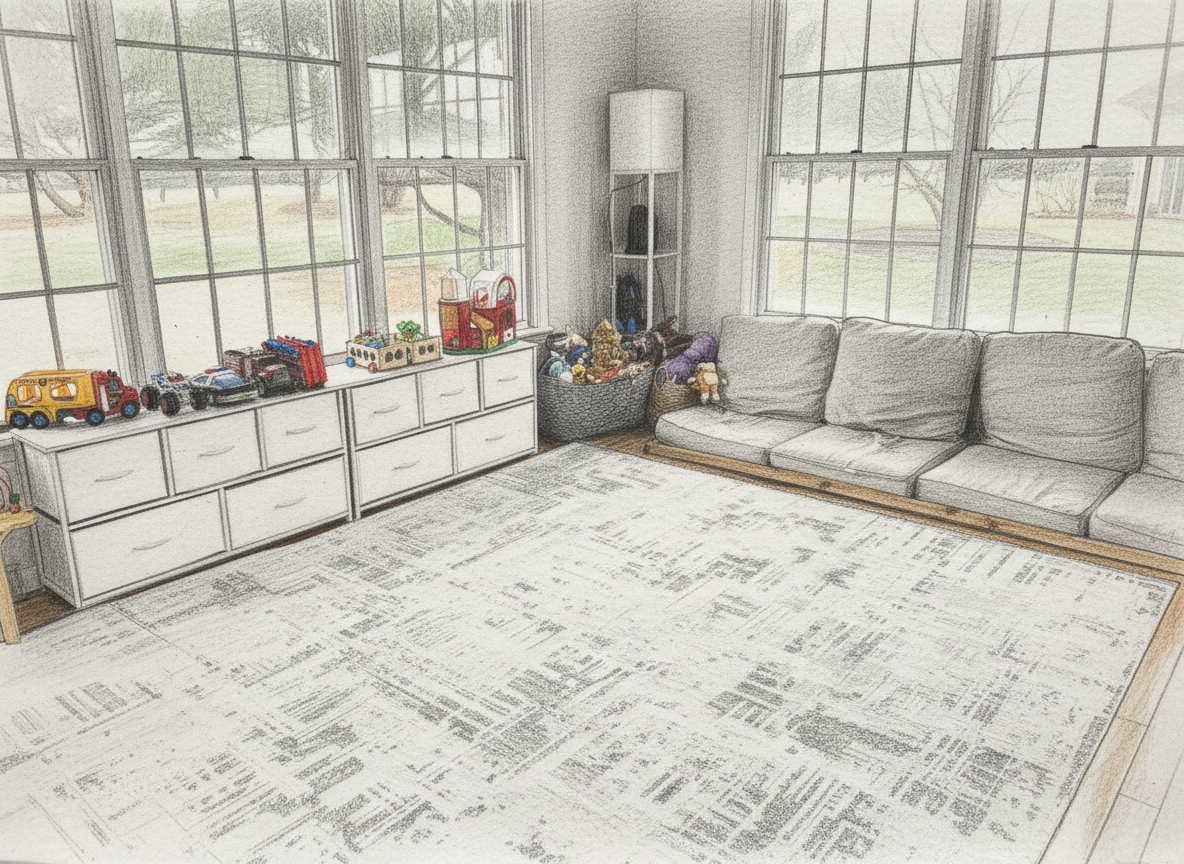
- The Sight-Line Strategy: By moving our playroom into the sunroom (right off the kitchen), I traded a “fancy room” for a “functional life.” I can now finish dinner prep while my toddlers build a magnetic-tile city ten feet away. They are out from under my feet, but within my circle of connection.
Architecture for the Small Footprint
Coming from such small beginnings, I am absolutely aware that not every home has a formal dining room or sunroom waiting to be sacrificed. If you are living in a standard three-bedroom ranch or a cozy apartment, your “central” space is likely your living room.

The Artist’s Pencil approach to a small living room isn’t about adding a playroom; it’s about integrating one.
- The Camouflaged Worker: This is where we swap the traditional bookshelf for a low-profile media console with closed doors. It holds the TV, yes—but the bottom cabinets are the “Dinosaur Drawer,” the “Block Bin,” and the “Vehicle Fleet.”
- The Dual-Purpose Surface: The top of a low console or coffee table is the perfect height for a toddler to use as a play table. By day, it’s a construction site; by evening, once the 5-Minute Reset is complete, it’s just a clean piece of furniture again.
The Social Friction (The “Messy” Truth)
Let’s be honest: there is a certain “shame” in having your home look like a preschool the moment someone walks through the front door. We are conditioned to think the “public” areas of our home should be pristine. But when I think back to when I tried to hide the playroom and pretend that kind of mess didn’t exist in our house, my home ended up being messier than ever. The reality is that the toys WILL end up in the living room no matter what. By embracing that reality instead of fighting it, it became possible for me to clean up the mess in mere seconds because the toys now had a home that was right where they were being played with. It became just as easy to put the toys away as it was to leave them lying out.

My Thriving by Design secret: A central playroom is only chaotic if it doesn’t follow my [abundance, not surplus] rule.
- Minimalism Matters: Because the playroom is central, the 5-Minute Reset is your most important rhythm. It’s the “eraser” that clears the canvas. And it’s only possible when you’ve paired down the toys to the ones that work the hardest: [My Favorite Toys for Encouraging Independent Play]
- The “Unexpected Guest” Confidence: When your toys have a designated “drawer” or “cabinet” mere inches away from the mess, you can go from “toddler explosion” to “serene living room” in the time it takes a friend to walk from their car to your porch.
- Prioritizing the Residents over the Guests: We spend 99% of our time with our family and 1% with guests. Why design your home for the 1%?

The Pivot to Independent Play
Moving the playroom to the center of our home was the single greatest catalyst for independent play in our house. When my kids don’t feel “sent away,” they are free to settle in. My playroom is more visible than it’s ever been, it’s also never been more played in. The kids actually engage with their toys and siblings for a few hours each morning and afternoon, which gives me the freedom to do the tasks necessary to maintain my hardworking home. So embracing the mess has actually made my home the cleanest it’s ever been.

If you find yourself constantly fighting the toy migration, stop fighting. Look at your floor plan. Where is the “Hearth”? Move the toys there. It might feel like a “messy” choice at first, but you’ll soon find it’s the most organized decision you’ve ever made.
Is your playroom tucked away or at the heart of your home? Does the thought of moving toys into your main living area give you peace or a panic attack? Let’s talk about it in the comments!
Next Up: The Hard-Working Kitchen: A Helping Hand for the One-Handed Mama.