
The Philosophy: The Open-Ended Toy Box
In our large family, every inch of space counts. So, every item in that space counts too! I wield my home’s design like an Artist’s Pencil—one handy tool that can serve a myriad of functions. Not only do I need multi-functional furniture pieces, like my [DIY Multi-Purpose Montessori Baby Couch], but I also expect the toys in my playroom to be versatile.

The “Big Six”: The Toys that Always Make the Cut
These are the high-performers in our playroom. The ones that survive each toy purge. I look for “open-ended” pieces that don’t do the playing for the child. As a “Mom of Many,” I’m too busy keeping track of how many kids I have to keep track of missing toy pieces; a toy only stays if it can lose a piece and still function. And with a bunch of toddlers whose favorite toy is “whatever Brother or Sister is holding,” I aim for toys with multiples that can be shared easily.

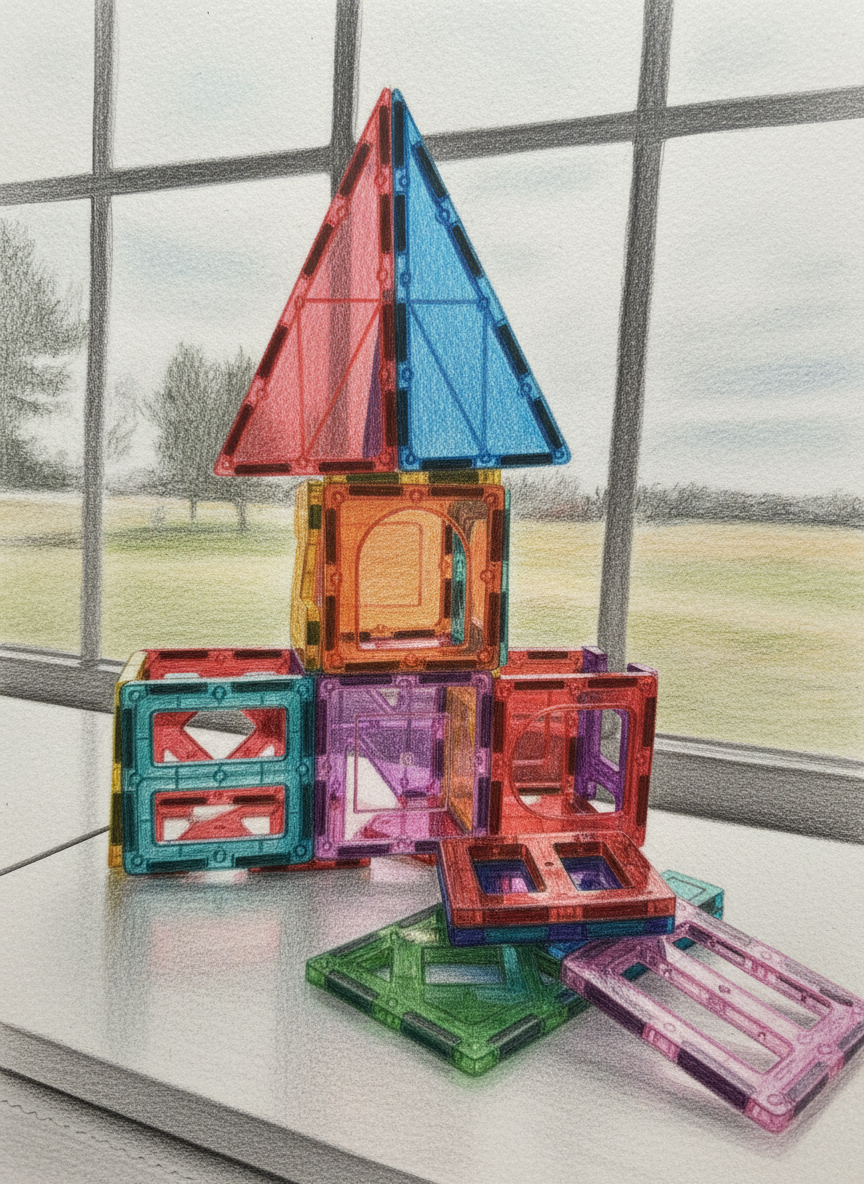
Magnetic Tiles & Blocks:
The ultimate building blocks of imagination. These can be used for sorting, counting, stacking, patterns, or as magnets on the fridge. The babies’ favorite way to use them? “Build Up—Knock Over.”

Things with Wheels:
Cars, trucks, and monster trucks that move as fast as the kids do. My kids especially like the kind that self-accelerate when you give them a little push.

Food/Pretend Play:
Encouraging the “[Hard-Working Kitchen]” spirit early on. Kids love to do what you are doing. Providing fruits, veggies, pots and pans to play with inspires hours of imaginative “pretend-to-be-Mommy” play

Sturdy Board Books:
Build a library that can withstand “enthusiastic” page-turning. I recommend avoiding the pop-up style books, however. Those only pop-up for a few short days, before immediately “popping” into the trash bin when the flimsy cardstock is dutifully ripped out. If you have an “Ollie’s Outlet” nearby, they have THE BEST prices on books! But discount outlets like “TJ Maxx”, “Ross”, and “Burlington” usually have board books at reasonable prices too!

Animals & Dinosaurs:
Small figures that turn a rug into a jungle or a prehistoric valley. Plus, they double as props for [Toddler Circle Time] songs like Old McDonald and Five Little Monkeys Jumping on the Bed!

The “Energy Release” Fleet:
Indoor scooters and push carts for when the playroom is “at capacity”. I recommend things with soft rubber tires to protect your floors. The key here is things that get them moving and burning off energy!

Bonus – The Toys that DON’T Live in the Playroom: There are a few types of toys that I love for my children to play with, especially my three-year-old. But with a lot of little pieces, I don’t allow my children unlimited access to them. If you want to learn more about these toys, check out my [Favorite Preschooler Quiet Time Toys] post here.
The Infrastructure: The Canvas Drawer System

- Super Functional – Simply Designed: In our playroom we chose to go with inexpensive canvas drawer systems to store the hoard of toys. The white color provides a calm, blank canvas to hold the splatter of play that happens daily.
- The “No-Stress” Storage: It’s a fine balance in motherhood to find items that are “cheap enough to replace” so you aren’t stressed about life happening, but sturdy enough that they don’t immediately disintegrate when play commences. So far, these storage bins have earned their keep on both fronts.
- The Mess Contained: “A drawer for everything, and everything in it’s drawer.” That’s the motto in our playroom. Limiting the types of toys means that I have enough drawers to put something different in each drawer. The kids know if they want a dinosaur, they need to open the dinosaur drawer. It’s crucial to make sure that each drawer isn’t overflowing. If it is, it means there’s too many of that type of toy.
- Low Profile, High Function: They are low to the ground, so the top surface pulls double duty as a perfect toddler-height play table. Plus having everything within reach of little arms, encourages independent play and independent clean up.
- Home for the “Giants”: When it comes time to clean up, the tops function as the home for storing those larger items like barns and firetrucks that don’t quite fit in the drawers.

The Playroom Rhythm: The 5-Minute Reset
- The Reset Ritual: Let’s be realistic, the playroom is not always clean. But, it is definitely realistic for it to be clean at least twice a day. Before naps, and before we head upstairs for our [Mom-of-Many Evening Routine] I enlist all the kiddos and we do a speedy 5-minute cleanup. This resets the playroom for the next shift when the babies wake up in the morning and after naps.

- The Psychological Win: I cannot thrive in a cluttered space. I feel my most creative when my environment is serene and secure. Kids are the same way! No-one wants to play in a messy playroom. If you are thinking, What’s the point, it’s just gonna get messy again? I challenge you to view it from this perspective. 5 minutes now results in a few hours of independent play later! That is a huge return on investment. Plus, establishing the rhythm of two 5 minute resets each day, will instill the value in your children that once play is done, the space goes back to baseline. This is a priceless ethic to impress upon your children in their formative years.

- Minimalism as the Engine: The only way for this routine to be sustainable is to have less toys in the playroom. In our home we live by the philosophy of [Abundance, not Surplus]. Even if every toy is dumped out onto the floor (which happens often to be honest), they can all be picked up and sorted back into their designated drawers in less than five minutes because there simply aren’t that many toys.
Your children don’t need more toys to play more. They need less toys that are carefully selected for imaginative play and an open space to play in.

The Messy Middle: Transitioning from Playroom to the Secondary Play Zone
There is a specific time of day every homemaker knows well: the playroom is ‘spent,’ every toy dumped out, the floor is a sea of magnetic tiles, and you are elbows-deep in the kitchen. In our house, we call this The Messy Middle.
When the playroom is overstimulated, the children naturally migrate toward the kitchen and dining room. Instead of fighting that movement, we embrace it with our Indoor Fleet. We bring out the indoor scooters and push carts. While I finish the dishes or prep dinner, the kids zoom through the kitchen and dining areas, burning off that ‘transition energy.’ It’s a gross-motor pivot that keeps them near me and engaged while the playroom waits for its 5-minute reset.

To be honest, it has turned the time of day I dreaded most to the time that creates my most cherished memories. I look around at the six children zooming in happy circles, squealing with bursts of cackling giggles and I think to myself “Look at the love we’ve created here!” This is yet another example of how I’ve gone from surviving motherhood by default to thriving in motherhood by design. If you notice a particular moment of disaster that happens in a regular rhythm, don’t be discouraged. Look at it as a moment of opportunity for more intentional design. Don’t fight the rhythm, embrace and optimize it.
The Proximity Rule: The Where Determines the How Long
Even the best open-ended toys won’t get played with if they are tucked away in a back bedroom or upstairs. I’ve set up elaborate, beautiful playrooms that my kids absolutely would not set foot in unless I was sitting in there beside them. Children are drawn to the ‘hearth’ of the home—wherever you are. In this house, we chose to put our playroom in our sunroom, right off the main living area. Because it’s central to the happenings of life, the kids are happy to stay there independently while I’m in the kitchen. (More on why we chose this layout in my upcoming post: [The Centralized Playroom]).

What toys consistently make the cut in your playroom? Do you rotate through toys? Or are you absolutely drowning in a sea of rainbow-colored plastic, with children clinging to your leg saying Mommy play with me!? I’d love to hear from you in the comments below.